The Future of Learning

by talkbackty on Aug 21, 2012

"The illiterate of the 21st century will not be those who cannot read and write, but those who cannot learn, unlearn, and relearn." ~Alvin Toffler


Our knowledge and understanding of the world is increasing exponentially. Barely a week goes by without a new discovery being heralded by our best and brightest. The world, or rather our perception of it, is in a constant state of flux. Yet our systems do not reflect this fact. We live in a series of 19th and 20th century systems that try to handle our 21st century realities. Those systems will fail. Some by gradual transition, others by paradigm shifts that will immediately disintegrate their necessity. We must prepare for that reality.

The public education system was created as a direct response to industrialization. As industry grew, a large and educated workforce was needed to fuel the fires of our nation's largest factories. The mantra at the time, and one that still permeates modern education, was 'reading, writing and arithmetic' or the "three R's". If you went to any public school in the world, chances are you're familiar with the three R's.

As Toffler suggested, the 21st century will be one where the illiterates are those who can not learn, unlearn and relearn. The most dangerous thing that can happen to someone living in the 21st century is that they believe they can stop learning. The reasoning is simple, those who do not change will be left behind.

Let's use economics as an example. Both Blockbuster and Hollywood Video were titans of the home video market. While local stores existed, these two franchises were the go to for an entire country's rental entertainment. Today, they both have closed thousands of stores and limp around, practically begging for customers. Neither anticipated the power of the internet or of streaming technologies. They relied on their 20th century knowledge while trying to operate in a 21st century world. Blockbuster and Hollywood Video were left behind, but the same thing can happen to an individual.

Quantum computing, personalized medicine, generation 4 nuclear power, 3D printing, robotics, nanotechnology, global intelligence. That's seven paradigm shifting, viewpoint-shattering developments that will happen within my lifetime. Those are the easy ones to predict. There's a host of things we do not know about that will rock our collective consciousness. What we do know is this: We must be prepared to change our minds.

The most important thing for us to do is change our approach to knowledge. It never ends. We can not stop learning. We can not believe that school is the only place where learning happens. Because of exponential growth it no longer takes a lifetime to feel out of touch, it takes a decade. In a few decades that time will shrink further, and those who can not adapt will be left behind in the span of a year. And it is those who are left behind we will deem illiterate. Too stubborn to learn, unlearn and relearn.

Let us not be left behind.


BATmitzvah

by talkbackty on Jul 16, 2012

*There are no spoilers here.


Someone's BATmitzvah is a special day. One to be held in high esteem compared to other days. For seven years, in fact for all time, no one has had a BATmitzvah. The world has suffered because of this. 


A BATmitzvah is the day you become a man or woman. It is the day you leave one stage of your life and enter into another. A person's BATmitzvah is a once in a lifetime occasion.


Thursday July 19th is my birthday. It is also the first day in the history of the world that anyone will be able to experience their BATmitzvah. 


The rules of a BATmitzvah are simple: In a 24 hour period you must watch all three Christopher Nolan Batman films. Batman Begins, The Dark Knight and The Dark Knight Rises.


After a BATmitzvah you will be filled with so much awesomeness that some family or friends may not recognize you. They may ask, "Tom you look so different, almost like you are glowing. What is going on?" Fear not in telling them the good news. 


Spread the message of the #BATmitzvah.

I wish you well my friends. I will see you on the other side.


The Future is a Video Game

by talkbackty on May 21, 2012

2011 was a pretty good year at the box office. Despite the industry claiming that their world will soon end because of piracy, ticket sales do not lie. Harry Potter 7 Part 2 made $169 million in a weekend, the highest of all time before The Avengers. Transformers, Twilight, Pirates of the Caribbean, all had blockbuster years at the box office.

And each one of them got their ass kicked by video games.
Harry Potter 7 Part 2 was the highest grossing film of 2011 and made huge waves for having a $92 million opening day. Modern Warfare 3 made $400 million in 24 hours. In five days it passed $750 million, a mark Harry Potter took nearly two weeks to pass. Transformers 3 came in second place at the box office and over its entire run made $350 million in the United States. Elder Scrolls V: Skyrim made $450 million in five days.

And video games are terrible.
Video games lack so much creativity that Mario is still a best seller. Imagine if you went to the movies and Marty McFly was having another grand adventure with Doc Brown. That's what video games are like. For those who don't understand the reference that's because Back to the Future came out in 1985, a few years AFTER everyone's favorite plumber.

But it doesn't matter. Because video games are the future.
Over the past decade gaming has become mainstream. With the explosion of home consoles like the Xbox and PlayStation and with the culmination of "casual" games on smart phones and social networking sites like Facebook, games have become entwined with our way of life.

And it is only going to continue.

With the exponential growth rate of technology there is no doubt that video games will soon dominate our conscious lives. Currently it takes a certain kind of dedication to become truly entrenched in a game. There are far too many barriers to immersion for most people to sink into a game. Controllers can be foreign to non-gamers, screens can't replace real life.

But the barriers will fall away.

As time passes, technology will become easier to use, more user friendly and more connected to every day tasks. Just last week Google patented an infrared ring that users wear on their finger to control interfaces on augmented-reality glasses. Microsoft is releasing the Kinect for PC this year, which will likely replace the keyboard with swipes of the hand and voice commands. If those are not two sentences out of a sci-fi novel, I don't know what is.
Gaming, as it's known today, is the real future. Just as it only took a few years for smart phones to become the majority of cell phones on the market, the gaming revolution will happen faster than we can understand. It won't happen when a gaming company invents a new technology, or programs a new graphics engine so that monsters look awesome. Those things will already exist. True innovation isn't about invention but combination.

The transformative moment is not Google's Project Glass or Microsoft's Kinect or any single idea. The transformative moment is when a game is released that combines so many different elements that it becomes more than a game, it becomes a way of life. At first there will be a relatively small group, as there always is. Then that group expands. What's going to be different about the video game revolution is that it will have no reason to stop expanding.

The common quip is, "That sounds like something out of a sci-fi movie." No arguments here, there are countless books, essays, shorts and movies that all predict a similar kind of future. What may be unclear is that books and essays and movies are just ways of bringing imagination into reality. When technology advances to the point when an all-encompassing "game" is feasible, all those writers and filmmakers and all the fans of those writers and filmmakers will become the first wave of gamers. Science fiction is the imaginative precursor to manifestation in the physical reality.

A new book will soon be released by TED that discusses the Hybrid Reality that will exist for the next generation. Life will be lived as a hybrid, taking place in both the physical environment and the virtual one. Robotics will continue to take on greater workloads in the physical environment while humans become more involved in the virtual worlds we create. According to Hybrid Reality, "what human civilization needs more than anything is not greater IQ or EQ, but TQ: technology quotient." The ability to adapt and use advanced technology.

Which makes for an interesting debate between those currently using technology and those who are out of the loop or shunning it entirely. If you're reading this then chances are you fall into the former camp, and my position should be fairly obvious. With time the differences will become even more stark. Since birth there are those who have been upping their technology quotient, preparing, in a way, for the video game revolution. Now that the future looks so bright there is only one thing to do...

Keep gaming.

~~~~


Continue the conversation on Twitter or G+.


How 'The Avengers' Did Right by this Geek

by talkbackty on May 4, 2012

Never before has a project like The Avengers been attempted. It is hands down one of the riskiest ideas ever kicked around Hollywood. Immensely successfully franchises are derailed all the time by a terrible sequel (Spiderman 3, X-Men 3). Yet Marvel's new plan was to produce multiple movies introducing individual super heroes with the end goal of bringing them together in one movie depicting one of comic book's most beloved teams. Make no mistakes about it, The Avengers is really Marvel Comics 6.

The story of The Avengers begins in a meeting between Marvel studios and Merrill Lynch in the pre-recession golden years of 2005. Merrill Lynch gave Marvel a big ol' pile of money in hopes that this superhero craze, that I refer to as Wave One, would continue and make everyone involved more piles of money. It was a huge risk, especially since at the time Marvel was witnessing DC Comic's release of Batman Begins capture far more critical and box office attention than their own movies had received of late. Marvel got the loan from Merrill Lynch, probably financed by selling some poor family a house they couldn't afford, but who cares because movie history for the rest of us!

Wave One/Wave Two

Speaking of history, here's some that I've been storing in my head for years in case a random facts moment was needed at cocktail parties. The comic book resurgence began in 2000 with director Bryan Singer's take on the X-Men. It would continue for years dominated by Marvel movies that redefined what comic book adaptations could do.
The superhero genre was previously viewed as niche films that people like Kevin Smith would see, but would never garner mass-appeal. DC Comics also was clearly ahead of Marvel in the cinema department. The 80's were dominated with Superman and its many sequels while the 90's (beginning in 1989) were dominated by Batman. In that same time Marvel released Howard the Duck, The Punisher, a direct-to-video Captain America and Blade. Not exactly cinematic powerhouses.

Bryan Singer would change all of that with X-Men. A far more serious look at comic book heroes, Singer was able to launch the first Wave of the superhero resurgence with his gutsy film. Marvel would ride Wave One for seven years with two more X-Men sequels, three Spiderman movies, two Fantastic Four films, Ang Lee's Hulk, Daredevil, Elektra, Ghost Rider and a Punisher remake. In seven years Marvel released three times as many superhero movies as it did in the previous 70 years.

While Wave Two technically began in that fat cat meeting back in '05, the real wave began with the release of Iron Man in 2008. Robert Downey Jr. charmed both audiences and Ms. Potts to new heights and Iron Man launched a trend. It was the first time a movie truly had two roles- to be a coherent film while also being a prelude to a project down the road. Each of the Wave Two films would have to deal with this balancing act. Some faltered (Iron Man 2, Thor) while others shined (Captain America). It's tough to iterate how unprecedented this plan was so let's try an SAT association test to prove my point. If The Avengers is the Lord of the Rings trilogy then Iron Man, The Incredible Hulk, Iron Man 2, Thor and Captain America are The Hobbit. $780 million on a prequel. Unlike The Hobbit, those in charge didn't know how successful The Avengers would be. They were guessing, like every studio guesses that it's next film will be a hit when the truth is they know about as much as audiences do about the next film's success. But that's what The Avengers is, the main event. Everything before this has just been a prequel so we know what is happening in The Avengers. It's been a five year study in mass-psychology and the results are in: we can be taught.

Each of the Waves represents a change in how comic book movies are presented. Before Wave One they were popular and had dedicated fan bases, but lacked mainstream appeal. Wave One changed that. It made comics cool again, made fandom a desirable trait and captivated the world in a way that had not been seen before. Wave One made it okay to tell a story through a superhero lens.
Wave Two changed how comic book movies were presented again. No longer would it be okay for characters to exist in their own individual universes. The same phenomenon that happened in the comics industry had jumped into the film industry. Once these characters are presented and we, the audience, know their stories we want to see them together. The Avengers is the culmination of years of work and dedication by the whole Marvel enterprise.

DC Comics

Titans of the previous generation's youth, DC has become second tier in the movie business during the 21st century. Since X-Men, DC Comics has released seven films compared to Marvel's twenty-four. While two (and the upcoming conclusion) can be quickly named, outside of Christopher Nolan's Batman franchise it is difficult for the average person to name any of DC Comics other films. Catwoman, Superman Returns, Watchmen, Jonah Hex and Green Lantern. Two were unmitigated disasters that did not recoup their costs (Catwoman, Jonah Hex), two made up their budgets at the box office but after accounting for marketing and licensing costs still are considered failures (Watchmen, Green Lantern), only Bryan Singer's Superman Returns can claim anything close to success, yet it was so routinely dismissed by fans and critics that no sequel was ever made. Audiences basically said, look we went to see this flick because it's about Superman, whom we love, but your movie sucked.

A brief aside for fans of Watchmen 


Look guys (and statistically speaking, yeah it's guys), Watchmen was awesome. It was the greatest interpretation we could ever hope for and I love Zack Snyder for making it happen. Compared to the rest of DC's non-Batman fodder, it's the only one that's any good. The problem is that Watchmen is not really a superhero movie as people came to know them during Wave One and Wave Two. It tried to be something else. Something more align with it's source material, something challenging and interesting and unique. To be blunt, Watchmen tried to be Batman Begins. In my opinion and most fans' opinions, it worked. The problem is that the Watchmen are not Batman. When you do something challenging and interesting and unique with characters that the general population is not familiar with it is easy to dismiss. Even when Chris Nolan did a very similar thing with Batman. I know, it's not fair. Watchmen was awesome, and I feel really bad about lumping it together with garbage like Jonah Hex, but the truth is that there aren't enough people like you and me. There's a bunch of normies out there who are reading this thinking, "this is a strange and weird aside, can we get back to The Avengers." No, normies, we can not. You should have seen Watchmen in the theaters. And Scott Pilgrim vs. the World. Now back to The Avengers.

Batman

Before we get back to The Avengers, I need to talk about the $1.3 billion elephant in the room. That's how much money Christopher Nolan's two Batman films have made. $1.3 billion. But the most important part isn't the money it's the man. It's not DC Comic's Batman films, it's Christopher Nolan's Batman films. There is absolutely no one else like him. His take on Batman is worthy of it's own wave- Wave Nolan. Exactly as Wave One/Two marked changes in comic book movies, so to did Wave Nolan.

Christopher Nolan's Batman Begins and The Dark Knight are so perfectly crafted that they transcend any singular superhero. In fact, Nolan's Batman is so far beyond any single superhero that it is strange to even put them in the same category. While Iron Man was getting drunk, The Dark Knight showed audiences insanity, depravity, pure evil, and sacrifice on an unparalleled stage. Other filmmakers appear to be telling stories about superheros while Nolan was telling stories of super-heroic proportions. Before the release of The Avengers it was impossible to think another film could challenge Nolan's The Dark Knight.

The reason for this is two fold. Firstly, Christopher Nolan tells complete stories. Batman Begins and The Dark Knight do not have to be seen together. While it's difficult to follow anything going on in The Avengers if you're unfamiliar with the numerous prequels, The Dark Knight stands on it's own just fine. There is no question that the films complement one another, but they are not supplements of each other.

Secondly, Christopher Nolan knows how to be Christopher Nolan. There is a tone and feeling when someone enters a Nolan film. It's not that we know what the movie is about (Inception) but rather we understand we are watching the work of a master. One of my biggest pet peeves is movies not understanding what they are supposed to be. Often this is a side effect of a multimillion dollar production with hundreds or even thousands of viewpoints all jockeying for a chance in the spotlight. John Carter is a perfect example of a film made by people who didn't know what the film was supposed to be. Maybe it started out with a clear vision, but over time and a thousand screaming voices that vision was lost. Christopher Nolan knows how to deliver the concept behind 'Christopher Nolan'. His films are perfectly constructed despite the fact that there are just as many people screaming for attention on Nolan's sets as there are on everybody else's.

Saying that a movie knows “what it is supposed to be” means it has one solid artistic vision and that vision is noticeable in every detail from casting to editing. Fast Five is a film that knows what it is supposed to be- awesome popcorn flick and a hell of a lot of fun. Pirates of the Caribbean 4: On Stranger Tides is an example of a movie that didn't know what it was supposed to be- continuation of old characters? introduction of new ones? exploration of grand mythology? random treasure hunting flick? Johnny Depp being Jack Sparrow? A clear artistic vision is needed for a film to feel complete and whole. Christopher Nolan has been able to do that with Batman Begins and The Dark Knight.

The Avengers...finally.

The crazy thing about The Avengers is that it's better than the sum of it's parts. While nothing on this scale had ever been attempted before, the small-scale tests were not inspiring. The closest thing to The Avengers experiment were a few episodes of CW's Smallville that attempted to show the beginnings of the Justice League of America. Just like The Avengers, characters were introduced in their own episodes and some got multi-episode arcs exactly like Iron Man got multiple movies. The results were near disastrous. None of the JLA episodes of Smallville were critically well received, often citing the rushed pace, a confusing storyline or even complete cop outs like putting characters on the phone instead of in the fight. Die-hard fans, myself included, loved seeing everyone together but the nostalgic effect soon wore off and we were left with a few mediocre episodes. While TV and movies aren't directly correlated, many in the industry and fans across the world feared The Avengers would fall into the same traps that plagued Smallville.

Whedon to the Rescue

Joss Whedon has had a big 2012. All he had to do was direct The Avengers and it would have been the biggest moment of his career, but a much smaller flick called Cabin in the Woods- a genre mash up masquerading as a horror movie- managed to sneak it's way into theaters a couple of months before The Avengers. Cabin should have been a preview for what was in store when The Avengers finally graced the screen. The tight pacing, writing and editing apparent in Cabin all can be seen in The Avengers.

Already a cult hero for fan favorites like Buffy the Vampire Slayer, Firefly and Dollhouse, Whedon's name will now be at the top of every studio's list. If Christopher Nolan tells complete, realistic, gritty versions of his cape-wearing hero then Joss Whedon operates like the yin to Nolan's yang. It's not that The Avengers is the opposite of The Dark Knight, it's that they are two masterful films playing with different sides of the same coin. Each film knows what it is supposed to be, each has a clear artistic vision and each is a masterpiece.

The Avengers is whimsical. It is fun. It honestly feels like an adult came along and put together the scraps some toddlers were playing with and turned them into a skyscraper. That is not meant to be a slight to the other filmmakers, merely a way to convey how fantastic Whedon's The Avengers is.
The Avengers takes four superheros (Iron Man, Captain America, Thor, Hulk), four non-super-but-still-awesome secret agents (Nick Fury, Black Widow, Hawkeye, Maria Hill), and one sidekick (Agent Phil Coulson) and throws them together to fight Thor's adopted brother/demigod Loki who is acting as the point man for a race of powerful aliens called the Chitauri who are led by an even more powerful thing known only as "The Other" who, we discover in the first of two post credit scenes, is working for Thanos. Did that one sentence just blow your mind? Well then you should enjoy the hell out of the movie. It's incredibly complex, which is why so many were worried that this film would crash and burn like a Kryptonian escape pod.

Yet Whedon delivers all the goods. Each character is given their share of screen time, their stories both concluding the arcs begun in their individual movies and catapulting them to the next level of herohood (that should be a word). Whedon presents us with a sort of nostalgic whimsy. A time portal to our youth when things were fun and funny, where time passes unnoticed, where enjoyment is had at each and every moment. The Avengers transports viewers in a way that every film should but only the great ones do. That's the similarity between Nolan and Whedon, each of their films transports you, and we recognize that as a rare thing. The difference is in where they choose to take you.
In The Avengers, Joss Whedon favors the whimsical, the fantastic and the awe inspiring. The pure joy of watching our childhood icons bicker and fight and eventually come together to save the world is exactly what we've always wanted. Not just we, the diehard fans, but we, the human race. We crave that nostalgic whimsy and it is rarely seen in our world of 24 hour news cycles. In our world, there's a lack of giant green monsters punching demigods, not out of malice but out of playfulness- the way brothers punch each other. And that sucks because monsters punching demigods playfully is one of the most enjoyable things to watch. The Avengers fills that void. And it fills about every requirement one could burden a movie to fill. The Avengers is fantastic, and Joss Whedon made it so.
Last Panel

The Avengers made movie history. Yes, it looks like the box office is going to be astronomically high and for all those that needed it to be so- congratulations. More importantly, The Avengers is the culmination of an idea that should have never worked. No film franchise in history has banked so much on a single idea, and because of that, no film has ever lived up to such high expectations before. In the future we will show our kids The Avengers and its prequels the way our parents showed us Star Wars. It is a historic moment, so here's what I really wanted to say...

Thank you.

Minecraft in Classrooms

by talkbackty on Apr 14, 2012

Part 13 of the A to Z Blogging Challenge. To see all entries, click here.
This is another post in my series zen and the art of teaching. You can see them all here.

Minecraft is the greatest educational tool that has never been used. That's because it is new and a videogame, and if there's anything the educational system hates more than things that are new it is videogames. Minecraft's simplicity is what makes it so compelling. It is basically a version of legos. It lets the player build anything and everything they can imagine. Minecraft is by far the easiest tool that lets a person's imagination be seen by others.


Players could build a cathederal.
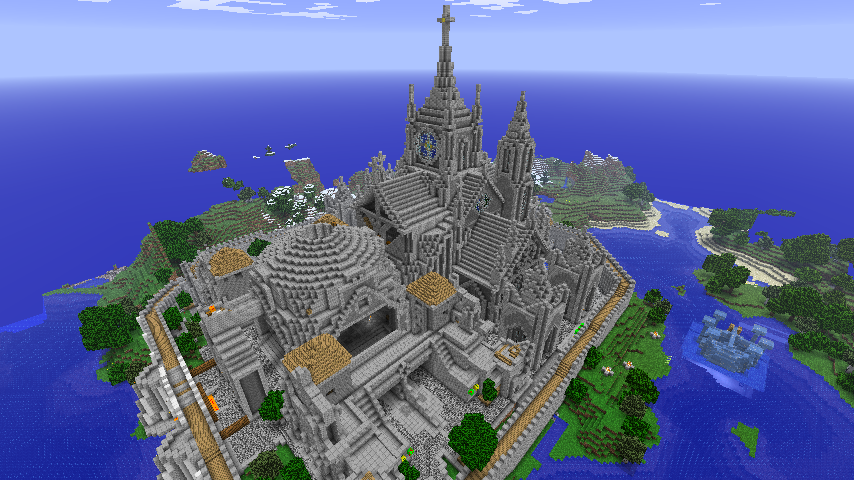
Or recreate a set from Lord of the Rings.
The game can be individual or played in groups. As a history teacher I may ask my students to build a French village. They may decide a village isn't challenging enough.
Limitless possibilities rarely present themselves in reality. In Minecraft the only limiting factors are a player's ability and dedication. Reality continually tells people not to try, to take the easy road, to get by instead of thrive. That's why high school is treated like a painstaking process students must survive instead of an opportunity to learn and grow. But what if by changing the manner in which problems are presented we can change the attitude of the participants.


Schools teach facts so that students can take tests where they can answer questions. What schools should teach is the ability for students to answer the question "what do you want to do?" Because when someone knows the answer to that question, all other questions become easier to answer. How do I do that thing? What are the challenges that will present themselves? How can I deal with those challenges?


Currently, schools try throwing a lot of tools at children and expect them to go into the world and know how to use them. Schools teach algebra in case you need algebra, writing in case you need writing, science in case you need science. But this is the worst possible way to go about learning. We have all had that thought, "Why in the world are they trying to teach me this garbage?"


When the first question is "what do you want to do" the second question is always, "how?" The how is what should guide the learning process. How do I become an astronaut? Science, mathematics, diet and exercise. By starting with "what" students will become self-motivated to figure out how. And self-motivation is the only lasting attribute any school can hope to teach.


Schools need to turn away from their roots as places where a person goes to seek facts and become places where people go to learn how to solve problems. Minecraft is a problem-generating simulation that allows for infinite creativity in the player's responses. But, above all else, Minecraft is a game that begins with the simplest of questions, "what do you want to do?" As in life, if you never answer that question then nothing else will work as well as it could.


Minecraft can be student's testing ground for the simple, driving questions that are so important to answer. And with those answers, they can create entire worlds.
~~~~~~~
If you have 20 minutes watch this TED talk by a public school teacher who presents a fantastic example of what I am trying to say.


Lacking

by talkbackty on Apr 13, 2012

Part 12 of the A to Z Blogging Challenge. To see all entries, click here.

Lacking ideas
Mystified by an inability to think
To create.
Lacking is life's motivator
Without it we would be content
And create.
Lacking fuels our passion
An unquenchable desire to be someone else
Someone creative. 


~~~~~~~~~~
Writing poetry makes me feel incredibly self-conscious. Mainly because it strips away a lot of the bullshit writers can cover their true intentions with. Less words equals less intrepretation equals less confusion. Writing anything other than poetry is just a way of confusing an audience. A way to be vague and mysterious because you are scared of being clear and transparent. 


I wonder if novelists would disagree.

Killing with Honor

by talkbackty on Apr 12, 2012

Part 11 of the A to Z Blogging Challenge. To see all entries, click here.

As has been the case throughout history, artists are the first to point out the problems of society through their work. Only after decades can historians speak on a topic with the same level of tenacity as the artist.


HBO recently began airing the second season of Game of Thrones. This clip is from the pilot. Ned Stark is lord of the city of Winterfell, he is surrounded by his men and sons as a military deserter speaks his final words. 


 For some reason very few people, and no world leaders that I am aware of, believe what Ned Stark believes. As he'd later say, "If you would take a man's life, you owe it to him to look into his eyes and hear his final words. And if you can not do that, then perhaps the man does not deserve to die. A ruler who hides behind paid executioners soon forgets what death is."


I don't know what it says about our society that so few people speak of honor. I just know that artists keep trying to, which means the rest of us must be in short supply. 

Joker: The Perfect Villain

by talkbackty on Apr 11, 2012


Part 10 of the A to Z Blogging Challenge. To see all entries, click here.

Heath Ledger as Joker in The Dark Knight is one of the greatest performances ever captured on film. Any person on the planet could spend a lifetime studying every frame of that movie and never be able to copy Ledger's performance. An actor's ability is just one part of the overall impression viewers are left with, the rest is created by the script, stylists, make-up artists, editors, cameramen, and, obviously, the director's vision. However, Nolan's Joker will be remembered as one of the greatest villains of all time because he represents a portion of humanity that exists within all of us, that bubbles underneath the surface, encompassing the thoughts we think in those still, small moments when we are alone. Joker is us, and that is why he is terrifying.


The first scene that attempts to explain Joker's particular brand of insanity occurs between Bruce Wayne and his faithful butler Alfred.

Joker is presented as a man "who wants to watch the world burn." A psychopath to the fullest extent imaginable, uninterested in any logical process and solely invested in bringing about chaos. A far cry from most "normal" people who only wish to live their lives pursuing the things that make them happy. But when Wayne questions Alfred about why a man would steal if uninterested in making money the butler's only response is, "...because he thought it was good sport." The Joker finds enjoyment and meaning in the things he does, that is what drives him. Is that not the same thing we are all seeking, to find enjoyment and meaning in the things we do?


Later in the film, when Batman is interrogating Joker, the villain comments on the "bad joke" society has created.
By saying that individuals are "only as good as the world allows them to be," Joker is setting up his final soliloquy. Of course, he is hardly the first to point out this fatal flaw in humanity. Every post-apocalyptic story ever told, written or filmed is about how quickly civilization can come undone. And those stories are a reflection of the horrors all around us, from poverty-stricken third world countries to the looting and rioting after Hurricane Katrina. Like an assembly line, the safest, more profitable areas of our world produce men and women of impeccable morality. But move those men and women to a place where they are continually threatened or fighting for the basic necessities and how long before their morals evaporate?


Joker's confrontation with Harvey Dent allows us to witness the creation of a villain. From high atop the social ladder, given everything the world had to offer, Dent follows the Joker's rhetoric down the rabbit hole until he becomes Two-Face.
Villains are two sides of the same coin. On one side are the schemers, those who believe that through planning and process power can be attained. On the other side are the doers, like Joker, who just act because it feels right. Most of us are somewhere in the middle, bouncing back and forth between schemers and doers. So if Joker is an example of a doer, who represents the schemers? The corrupt politicians and world leaders. The dictator who's people starve while he eats off a gold plate. All the people who figure out the system, and take advantage of the rest of us.


"You see, nobody panics when things go according to plan." The recent Trayvon Martin/George Zimmeran case demonstrates Joker's point. Passions are stirred and tempers are enraged for one simple reason...seventeen year olds are not supposed to die on the street while carrying a bag of skittles. That's not part of the plan. And when they do die on the street, society panics. 


Now imagine you could introduce a new way of thinking, a better way of thinking. A way that guaranteed everything was fair for everyone. How far would you go to insure that the world was fair? Would you tweet about it? Write a blog? Tell a friend? Protest in the street? Destroy a building? Would you be an agent of chaos if the cause was right?


As Joker says, that is all he is, an agent of chaos. Terrifying because viewers can see where he is coming from. Terrifying because he seems to say the things we feel. Terrifying because he blurs the line between fiction and reality. Joker is the perfect villain because everyone is afraid of becoming him. 


Institutional Memory

by talkbackty on Apr 10, 2012

Part 9 of the A to Z Blogging Challenge. To see all entries, click here.

Whenever you start a job at a new company it is likely that some middle-manager type will eventually give the introductory talk. This is their moment to wax poetic about the company's values, the mission statement and the family that you have now entered into. Really this is the moment when the company does its best to instill some institutional memory upon its newest employee.


A simple guess can give one a good definition of institutional memory, "The collective memory of a group, organization or institution." It is most easily seen in government bureaucracies. High turn-over at the upper levels, usually because of elections/appointments, would lead to utter chaos if it actually lead to drastic changes. Institutional memory is preserved by low turn-over in all areas other than the very top. Imagine a newly elected head-of-state trying to lead the government to the right or left, institutional memory allows the group to walk in whatever direction its head points.


All corporations, groups, organizations have some type of institutional memory in place. The difference between a company like Apple or Microsoft is in how dedicated individuals are to preserving that institutional memory. Therefore, it is incredibly beneficial for corporations, groups and organizations to work hard at perfecting their specific brand of institutional memory.


This is precisely why the public school system was invented. To further the institutional memory of a government and the supporters of governments- corporations. Regardless of what is said about the goal of schools today, historically, schools were designed to produce obedient workers who were intelligent enough to assemble things on a factory line.


As our society becomes more industrialized and corportized, it is more important than ever to realize the extent of institutional memory. Right now, buying an iPhone versus an Android is a big decision that can lock consumers in to various contracts, both legal and social. And companies are always attempting to increase their institutional memory by recruiting more willing spokespeople, namely, their own customers. Think about what is more valuable to you: The review of a close friend or a commercial on TV? Companies, governments and groups of every color know the answer is a close friend, and they will do everything in their power to encourage customers to speak favorably about them. When you buy a product or vote for a politician you are joining a club, often one with a long history that may or may not be important to you.


It is always valuable to keep the big picture in mind. We are so busy trying to put together the puzzle pieces of life that we forget to check the box every now and then for guidance. Institutional memory can be a blessing and a curse, but we should always be aware of it, and other large social forces that influence our thought process.


Hiking and whatnot

by talkbackty on Apr 9, 2012

Part 8 of the A to Z Blogging Challenge. To see all entries, click here.


Today, I went hiking with some friends.


It was excellent.


That is all.

Gaia Theory

by talkbackty on Apr 7, 2012

Part 7 of the A to Z Blogging Challenge. To see all entries, click here.

Ever have one of those moments when you desperately wish you were smarter? It happened to me as I was trying to formulate some thoughts on the Gaia Theory. It's a strange thing to read sentences, understand specific words, but be unable to fully grasp the meaning. My mental chatter went like this, "Okay. Got it. Interesting...I have no idea what this guy is talking about."

While the Gaia Theory at first glance sounds like some hippie version of, "everything is one, man" the actual science is fascinating. Even if it is a little above my head. The original hypothesis was suggested by James Lovelock who said that "all organisms and their inorganic surroundings on Earth are closely integrated to form a single and self-regulating complex system, maintaining the conditions for life on the planet." Instead of a planet that has trillions of individual organisms living on it, the planet herself is one system, exactly like our own bodies.

Think of that basic model children are taught about streams flowing to rivers flowing to oceans where precipitation occurs and rain falls, beginning the process all over. The Gaia Theory states that our planet and ecosystem are in the same type of closed loop, with all inputs forwarding the goal of keeping the planet primed for life to flourish.

The theory was proposed originally to address the unexplainable balances our biosphere has pulled off for billions of years. For example, ocean salinity has remained at 3.4%, oxygenation of the atmosphere hovers around 21%, and the surface temperature has not drastically altered for millennia (remember we are talking cosmic scale, yes temperature fluctuates between hot and cold, but it's never 78 degrees and sunny one day and -310 degrees the next. Think big picture). Despite the fact that according to models at the time none of these things should remain constant. Rivers continually dump salt into the ocean, atmospheric gases continually expand, contract and mix above our heads, and the sun puts out 25-30% more energy today than when life originally began.

Back when the Gaia Theory was still the Gaia Hypothesis, James Lovelock came up with a brilliant simulation that could test the concept of a planetary regulatory system. Named Daisyworld, the simulation used a planet with only two types of daises- one species black and the other white. The sun upped its energy production over time (just as ours does), which should have increased the surface temperature of the planet. When the planet was cool (think early in development) black daises flourished because they absorbed more light and eventually warmed the surface temperature of the planet enough for white daises to bloom. White daises reflect light, thus cooling the planet and acting as a balance to the black daises. What the simulation showed was that despite the sun's gradual increase of solar energy the surface temperature never fluctuated beyond the "prime zone" for daises to bloom. If the sun was turned down, black daises grew to raise the temperature of the planet, when the sun was turned up, white daises replaced the black ones and the planet cooled. This, effectively, was the first step in proving the Gaia Hypothesis.

Daisyworld was controversial when first introduced. Many scientists stated that because of the simplicity and lack of realistic variables the experiment was invalid. With the rise of computers capable of handling massive amounts of data, Daisyworld was revisited to prove/disprove the naysayers. Other factors were added, from the incredibly simple things like gray daises, rabbits and foxes to the complex like numerous flora and fauna, weather patterns and random death rates. Each time the simulation added biodiversity the planet became more efficient. The naysayers actually did point out Daisyworld's biggest flaw- simplicity. When complexities were added the system got better at preforming the Gaia Hypothesis.

After thirty years of work and numerous experiments from various scientific fields all pointing in the same direction, the Gaia hypothesis officially became a theory. In 2001, a thousand scientists at the European Geophysical Union meeting signed the Declaration of Amsterdam, starting with the statement "The Earth System behaves as a single, self-regulating system with physical, chemical, biological, and human components."

Which is kind of cool. Even if I barely understand it.


Fermi Paradox

by talkbackty on Apr 6, 2012

Part 6 of the A to Z Blogging Challenge. To see all entries, click here.

The theme of paradoxes continues! And with all paradoxes it is best to conclude, even before beginning, that we, as a species, know absolutely nothing. With that pleasurable introduction, let us begin.


This particular paradox, noted by Enrico Fermi in 1950, states that given the statistical probability of life on other planets why have we not encountered any alien species. 


First we must address the claim of a "statistical probability of life."  Our observable universe hints at there being 200-400 billion stars in the Milky Way Galaxy. Even a child can realize that numbers 200 billion apart means that someone is just guessing, and that's accurate. So let's just stick with "a really, really big number of stars."


From that point you play the 1% game. Let's imagine that of 100 billion stars (so I low-balled the guess of the smartest humans on the planet) one percent have any type of life. From bacteria all the way up to god-like beings. The rest of the 99 percent are just desolate stars who's planets have no life whatsoever. Kind of depressing. But we are not done. That one percent gives us 1 billion planets with some type of life. Let's imagine that one percent of those 1 billion planets with life have intelligent life. That's 10 million planets with intelligent life. But intelligent life can include all of human history, and while we were intelligent, things didn't get really interesting until a hundred years ago. So play the game again. Let's say one percent of the 10 million planets have advanced-intelligence, either at or beyond our own. That is one hundred thousand planets with advanced intelligence. Now if we stopped right there that is an incredible statement. 100,000 planets with advanced intelligence. But play the game one last time. Of those 100,000 let's say that one percent have advanced so far ahead of us that they would not even be recognizable, a supreme, god-like species. That is 1000 races bouncing around the Milky Way who are so advanced we could not even comprehend their existence. 


Now back to the beginning. Remember how I low-balled the estimate? Well I did not even bother to take in to account a galaxy other than our own. Scientist believe there are as many as 400 billion other galaxies, each with their own 200-400 billion stars. So those numbers I gave are really just a fraction of the actual number. What we are left with are numbers so staggeringly large that the possibility of advanced, intelligent species is practically undeniable. 


So where are they?


That is Fermi's Paradox. Here's a song that explains if that is more your thing. (Yes, it is an incredibly nerdy song about Fermi's Paradox...this is why the internet exists.)

As you can imagine there are dozens of theoretical answers to Fermi's question. From the utterly depressing ideas that all advanced intelligences eventually kill themselves or that one of the supreme god-like species actively kills anything that threatens it's dominance. To the rather practical belief that vasts distances are just as challenging of problems to overcome for our alien brethren as they are for us. You could probably rattle off four or five theories of your own and, trust me, they will be about as good as the leading experts'.


My personal favorite is the idea that there are intelligent beings (because math tells us so) and that they are broadcasting signals all across the galaxy, the only problem is that we are not listening. Our current methods of measurement are based on human perception- sight (telescopes) or hearing (microphones). We listen for radio waves because that is what we sent out in the 1920's. We block out white noise from our instruments because we can't understand it. Our universal observations are based on the abilities of a species (us) designed to eat fruit and drink water. We are entirely unequipped to contemplate the vastness and complexities of the universe, but we are doing our best. However, there is no reason to believe that other species are excited to communicate with the best we have to offer. When was the last time you chatted up a squirrel? 


I like this concept because it implies that we are merely unaware of something amazing and transformative, and once we figure out how to listen, the changes will come faster than we can imagine. This is basically how we operate our entire lives. As young children we believe the world is much smaller than it is and are blown away when it is revealed how small an area we actually live in. The further we push our understanding, the more clear that pattern is. The more we discover, the clearer it is how little we understand.  


One day, maybe soon, maybe not- I think we will wake up. At that point it will be like looking back at ancient Egypt. We are the half-remembered past of some future generation. School children will giggle at how advanced we believed our technology was as they wake up in the Andromeda galaxy and beam over to Kepler 22-b (nerd alert: those are actual places).  


The Fermi Paradox remains unanswered, but at least it is not because we have stopped trying. It is the trying that eventually leads one person to see or listen in the right way and wake us all up from the lives we lead. Then the process begins anew.


Ease

by talkbackty on Apr 5, 2012

Part 5 of the A to Z Blogging Challenge. To see all entries, click here.

Life, much like water, always seeks the path of least resistance. Trees bend with the wind instead of fighting it, wolves attack younger prey instead of going after adults, spiders build webs to lure instead of hunting their meals. But humans actively celebrate people doing difficult things.


Think of any accomplishment that has ever been bestoyed upon anyone. They are always for doing something percieved as difficult or challenging. "You climbed Mt. Everst, nice work, here's your photo on the cover of TIME." "You can throw a football really far, awesome job, here's $50 million." Even the participation awards given out to every young kid regardless of performance are still a way of rewarding them for doing something that other people are not doing. "You are here when you could of been somewhere else, here's a ribbon."


We actively seek ways to make our lives easier, but the moment life becomes too easy we start moving in the opposite direction. We build massive homes filled with running water and electricty and comfy beds, but people get bored by the ease of every day life and search for more challenging things to occupy their time. To our ancestors people of the present must appear deranged. "Let me get this straight, you have a magic box that brings you images from every place on the planet and you're so bored with life you're going to jump off a bridge?"


On one hand, it is because of the people who pushed boundaries that we have the amenities to make life easier. But on the other, it's an unsustainable habit that is only going to get worse over time. As technology continues to take the place of day to day tasks our lives will become easier. The question is, how will we fill our time?


I am perplexed by this thought more than anything else. I think that it is important to be happy with less, to find contentment without continually needing more and more. But I also realize that true innovation only comes because things are made easier. What must be understood is that things need to work in balance. To abandon all difficulties, whether it be climbing Mt. Everst or just climbing a set of stairs, would be as counterproductive as returning to the days before mass conveinces made our lives less about survival and more about enjoyment.

Disaster Day

by talkbackty on Apr 4, 2012

Part 4 of the A to Z Blogging Challenge. To see all entries, click here.


Humans have developed the paradoxical ability to predict massive, long-term trends through billions of data points while simultaneously ignoring those findings on a day to day basis. Our political leaders tout a return to more prosperous times even when the most educated men and women in our nation point out the unstainability of our policies.


Smart people out of MIT recently created a computing model to forecast different scenarios based on population growth, global resource consumption, agricultural productivity, birth control and environmental protection efforts. The long and short of it: By the year 2030 the world will be pushed into the Greatest Depression due to lack of resources and overpopulation. Article here.


This is an especially big blow to futurists who hoped that 2045 would be the year of the technological singularity (the year given by TIME last year in a cover story). This "saving date" now becomes irrelevant next to MIT's disaster date.


As in most situations, it seems that we are on the cusp of epic, paradigm-shifting future possibilities. On the one hand, mass death and depression because of a lack of resources, and on the other, a technological singularity that could be as important as the creation of language.


My thoughts on the matter can be summarized best by The Imaginary Foundation, "To imagine is to perceive many potential futures, select the most delightful possibility, and then pull the present forward to meet it."


Let's select our future instead of being destroyed by it.

Colors we See

by talkbackty on Apr 3, 2012

Part 3 of the A to Z Blogging Challenge. To see all entries, click here.


Colors are one of those interesting things that we, as a spieces, seem to understand but are entirely self-created. Admittedly, I am not an expert on colors or light so bear with me. It is rapidly becoming clear that I have something of a fixation on perception, since in three days that is where my mind landed twice. And colors are really all about perception. 


What we know is color is the reflection of light off a surface and into the receptors of our eye, translated by our brain, processed, labeled and, finally, understood. Despite the fact that our ability to visually percieve color is based on a narrow field of vision (the rainbow), we are remarkably confident about what things are which color. 


For example, let's look at a chair. Let's look at the chair Morpheus sat in during The Matrix...cause why not, it's the internet.


What color is it?


How about now?


Is it the same color as this?


Or this?


The hint is that I did not adjust the "redness" of any of those pictures. Each picture plays with the light source, turning it up or down. Most people's reaction is to say that the chair is red, just in the dark or light, but always a red chair. That is the brain's rationalization. That is the quick lie the mind tells itself to make sense of a chair our eyes' receptors said was one color and now telling us it is a different color. 


Color always fluctuates. It changes with the light source and with the perception of the viewer. The way we should look at an image is that there are objects and there are colors, not that objects are a color. 


Perceptions are important to constantly check and recheck because of our mind's tendency to seek laziness. Brains are bombarded with stimuli and spend day after day trying to simplify. Taoism talks about water that does not continually flow becoming a swamp. Our perceptions can also become swamp-like if we forget to update them.  


Once again, this observation is meant to point out how wrong we are in our day to day lives. And if someone who understands light better than me comes along and tells me this blog is complete nonesense, well then that is only more evidence- albeit evidence just showing that I am wrong on a day to day basis, not us as a collective. 


Think about it.


~~~~~~
Bonus Edit: I found a color test. I scored a 12. Zero is perfect. It takes a little time to complete. Best of luck.


Books Everyone Should Read

by talkbackty on Apr 2, 2012

Part 2 of the A to Z Blogging Challenge. To see all entries, click here.


Ever wake up one day and realize that over the years you've become something? Through time and dedication you barely registered as such, you have joined the ranks of some club/group/segment of the population. My realization came in high school when it became clear that I read a lot more than my peers. Even in college, the supposed pantheon of the educated, I still outpaced the men and women around me.


I read a lot. That is all I wanted to say. Because I read a lot and my interests are varied I have had the chance to read things from nearly every genre. And while books are slowly being replaced by online articles, blogs and videos as the go to medium for everyone, including myself, I thought a collection of my favorite books would be worthwhile.


Further ado; these are in no particular order.


The War of Art by Stephen Pressfield. I recommend this book to everyone. There's even a few copies I've given to students floating around out there with a message to keep passing it along, pay-it-forward style. Written in the same vein as its more famous cousin, The Art of War, this short book is all about overcoming the forces that stop you from achieving your goals. Is it a little self-helpy? Yes. Will some be turned off my the author's mystical tendencies? Yes. I do not care. It is great and everyone should read it.


The Postman by David Brin. The magnificent thing about a post-apocalyptic setting is that it removes all the social biases we are familiar with as readers. What we are left with is a picture of how the author really sees the world. Brin presents a harsh reality where America has fallen and one man struggles to survive but throughout everything he retains hope. And that's a message worth being reminded of. 


The Fault in Our Stars by John Green. Green (and his brother Hank. Nerdfighters!) Have slowly invaded my mind since I found them on youtube a few years ago. Both are inspiring individuals, but John is also one of the best young adult writers in the country. His latest book is a masterpiece. It is the heart-warming (and heart-breaking) story of two teens who meet at a cancer-support group. Funny, endearing and honest. Read it, then check out all the awesome nerdfighter stuff on youtube.


The Post-American World by Fareed Zakaria. If you are constantly flicking between Bill O'Reily and whoever MSNBC throws up to compete against him you owe it to yourself to check out CNN's Fareed Zakaria GPS. He is an Indian American reporter who graduated from Yale and Harvard, was a columunist for Newsweek, editor of Newsweek International and editor-at-large of TIME. The guy is smart, direct and well-spoken. In his third book he looks at the changing global landscape and how America is dealing with "the rise of the rest" (other nations getting power). It should be a staple for all those with an interest in politics, which in my opinion, should be everyone. Which is why it is on this list.


The Name of the Wind by Patrick Rothfuss. The first of the Kingkiller Chronicles. A fictional masterpiece about a young man who retells his heroic rise and fall. The author wrote the entire series years ago and has been editing and refining ever since. The result is some of the best prose one can find. Literary, sweeping and beautiful.


The Illustrated World's Religions by Huston Smith. My college textbook...at two different universities. It has become a staple of every religion department for good reason. Including every religion you've ever heard of and most you have not. Simple and beautiful, and as the title suggests, full of wonderful pictures. Enjoy.


Slaughterhouse Five by Kurt Vonnegut. If you are unfamiliar with this novel I will just give you the long-form title in hopes of sparking your interest. Slaughterhouse-Five, or The Children's Crusade: A Duty Dance with Death by Kurt Vonnegut, a Fourth-Generation German-American Now Living in Easy Circumstances on Cape Code (and Smoking Too Much) Who, as an American Infantry Scout, Hors de Combat as a Prisoner of War, Witnessed the Fire Bombing of Dresden, Germany, "The Florence of the Elbe, a Long Time Ago and Survived to Tell the Tale. This is a Novel Somewhat in the Telegraphic, Schizophrenic Manner of Tales of the Planet Tralfamadore, Where the Flying Saucers Come From. Peace.


Freakonomics by Steven Levitt. A look at behavioral economics in a humorous and easy to understand way. One of the first real efforts to take the heavily mathematically-inclined field of economics and make it digestible by the average person. Levitt seems to know exactly what chords to strike to enlighten and inspire.


Siddhartha by Herman Hesse. A powerful novel about the spiritual journey of an Indian man set around the fifth century BCE. This is a timeless tale and an excellent introduction to Eastern philosophy and religious beliefs.


World War Z by Max Brooks. The zombie book that will define zombie books for many if 2013's movie starring Brad Pitt is a hit. Regardless of the film, this book has it all. It is captivating, emotional and terrifying. Using a "reporter" to interview survivors of the zombie apocalypse, readers are able to experience an event from numerous different viewpoints. Even those not interested in the horror genre should be entertained by this novel.


My goal with recommending these books is not to showcase the greatest writers in the world. Notice how there is no Shakespeare, Twain or Hemingway. Instead, I am hoping to inspire. Each book is a nice intro to big ideas. Freakonomics is a great introduction to economics, and it is a topic I became really interested in during college specifically because of the book I read in high school.


Each book has the capacity to inspire and that is what I have always gotten from books. Whether it is inspiration to save the princess or fight off zombies or see the world. Books have a wonderful ability to transfer our consciousness to another realm. A realm where we create our own reality by dreaming. And I think it is a good idea to share that capacity with as many people as possible.